The Protection of the Theotokos
A Reflection for Men Who Still Believe in Courage
REFLECTIONSWISDOM & TRADITIONFAITH IN ACTIONMAN OF THE HOUSEBODY & SOULBEAUTY & ORDERFAITH & FIREEMPIRE & COLLAPSECULTURE WARTESTED BY FIRE
Contra Modernum
10/14/20254 min read

The Veil as Judgment
“Under your mercy we take refuge, O Mother of God.”
Modern Christians sentimentalize everything.
They take the fire of the Gospel and water it down into chamomile tea.
The Feast of the Protection of the Theotokos has been stripped of its steel and turned into a pastel image, a gentle mother wrapping her children in safety. This is not what the Church remembers. The Theotokos appeared in Constantinople at a time of peril, when the people faced invasion and death.
She did not come to coddle.
She came to cover the faithful as a commander covers her soldiers, those who stand ready, repentant, purified, armed with prayer and truth.
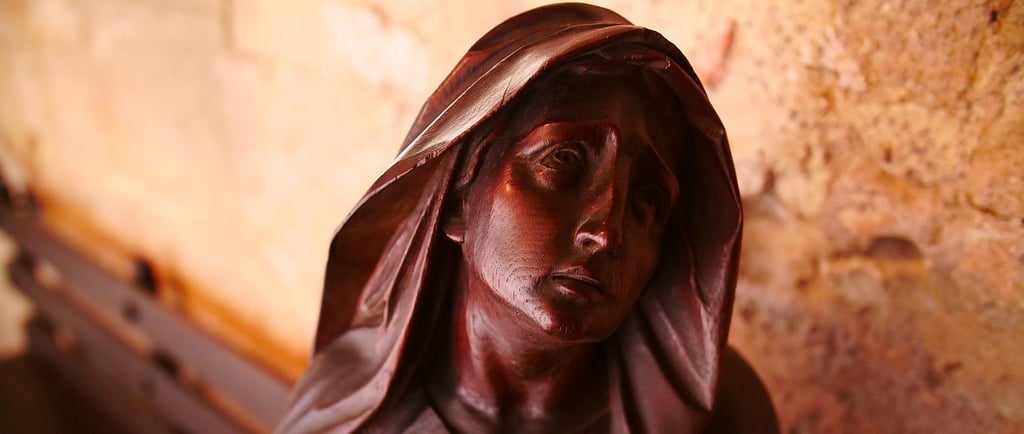
Her veil is not a blanket. It is a standard raised in battle.
It divides those who live under repentance from those who live under illusion. Beneath it, one cannot hide behind excuses, self-justification, or that modern euphemism for cowardice: “pragmatism.”
The veil of the Theotokos is for those who would rather die faithfully than live comfortably.
To take shelter beneath her veil is to accept a test: Will you live cleanly, speak truthfully, and fight quietly?
Her protection is not magic; it is moral.
It rests on the man who:
Protects his own family in prayer.
Defends the truth when mocked.
Who keeps integrity even when it costs him something.
The cowardly will not find her there. She covers soldiers, not spectators.
The Courage of Silvanus
Hieromartyr Silvanus and the Forty Martyrs of Gaza remind us that real courage is not noisy. The saints did not perform for audiences or issue press releases. Their courage was calm, not hysterical; steady, not theatrical. Theirs was the courage of endurance, the kind a man needs to keep his soul intact when the world demands that he betray it.
Our age rewards the opposite:
cowardice that masquerades as moderation,
compromise that pretends to be civility.
Every man who kneels before “social consensus” for fear of losing a job or reputation dishonors the Forty Martyrs, who died for a truth they could not deny. The martyrs stood firm not to “make a statement,” but because reality itself demanded it. That is conviction, to obey truth even when no one sees, even when it burns.
Brotherhood as Sanctified Loyalty
Nazarius, Gervasius, Protasius, and Celsus, four names forgotten by the world but thunderous in Heaven, show what real fraternity looks like. Their friendship was not built on shared pleasures but shared suffering. They did not flatter each other; they fortified each other.
The modern man calls friendship what is merely comfort, a collection of men who gather to commiserate, not to consecrate. Brotherhood without virtue is just collective weakness. Brotherhood aimed at heaven is divine warfare. If your friends do not make you holier, you have found accomplices, not brothers.
Paraskeva and the Death of Vanity
Saint Paraskeva sought obscurity and found glory. She gave away wealth, ignored praise, and fled the temptation to be noticed. The world cannot understand such a woman, it canonizes the loud and forgets the silent. The modern Christian influencer does charity only if there’s a camera on. Paraskeva’s holiness was invisible, and therefore real.
Vanity has learned to disguise itself as piety.
People post their good deeds online with captions about humility. But humility that announces itself is pride in costume. The saint’s life exposes us: she had no need to prove her goodness to the world because she lived before God alone.
The Renunciation of Power
Prince Nikola Sviatosha abandoned his throne to become a monk. That is not weakness, that is strength beyond comprehension. The modern man cannot imagine renouncing power; he craves control, authority, and validation. Yet Nikola found peace only in surrender.
He teaches that the man who cannot obey cannot lead.
The world calls obedience slavery, but disobedience to God always ends in servitude to self. Every tyrant is just a man who refused to kneel. The strongest ruler is the one who has first mastered his passions.
The Sanctity of Solitude
Saint Cosmas of Yakhrom prayed in silence and poverty, yet heaven heard him louder than the bishops of his time. He proves that prayer does not depend on eloquence but endurance.
A man who can remain still before God will shake the world without lifting a finger.
Our age despises silence. We fill every second with noise, because stillness forces us to confront our own emptiness. But the saints remind us: the man who cannot bear silence cannot bear God.
The Armor of Endurance
Faith under fire.
Courage under persecution.
Brotherhood under trial.
Humility in secret.
Peace through obedience.
Prayer through stillness.
These are not abstract virtues; they are weapons. Each forged through pain, each tempered by endurance. The saints lived as soldiers of light, not citizens of comfort.
To the modern man, these lives seem absurd:
too severe
too ascetic
too costly.
But what has modernity bought with its cheap grace and cheaper virtue?
Anxiety
Division
Impotence
Despair.
The saints were not miserable in their renunciations.
They were free.
The True Shelter
The Theotokos still spreads her veil, not over nations, but over souls. She shelters those who dare to live with spiritual clarity in an age of confusion, those who still believe that manliness is measured by endurance, not appearance.
Her protection is not sentimental but strategic. It is the shield of those who refuse to sell their conscience for comfort. Beneath it, men are remade, no longer consumers of religion but combatants in the war for their own souls.
To stand beneath her veil is to declare that you will not be ruled by fear, fashion, or falsehood. You will not surrender your faith for applause. You will guard your home, your prayer, and your integrity like a man defending a fortress.
The saints did not survive by adapting to the world; they overcame it by faith. The Theotokos did not protect the lukewarm; she covered the faithful. And that is the truth modern man cannot bear, that divine protection is reserved for those who dare to live dangerously in righteousness.
To live under her veil is to live as a soldier under command, to choose repentance over indulgence, to choose prayer over performance, to choose humility over display.
May we, in this cowardly age of comfort, recover the steel of those who lived and died beneath her mantle: unashamed, steadfast, and unbroken.
For beneath her veil, only the courageous can stand.